

From scepticism to a working view
Bitcoin is one of those subjects that attracts certainty. Some people are convinced it is the future of money. Others are equally convinced it is speculative nonsense waiting for gravity to reassert itself. I began somewhere in the middle: interested enough to look properly, sceptical enough not to take either side at face value. That turned out to be a useful place to start.
At first, the question was fairly simple: what is Bitcoin actually for? Not how the blockchain works in detail. Not how to buy it. Not whether the price was going up next Tuesday. The more useful question was: what problem is Bitcoin supposed to solve, and is that problem real?
That quickly opened a wider conversation: scarcity, fiat currencies, government debt, inflation, gold, financial repression, institutional adoption, regulation, energy use, volatility, concentration risk and, inevitably, whether everyone involved was simply talking their own book.
A quick note before you dive in
Our Bitcoin case study uses language from finance, economics and cryptocurrency that may not be familiar to everyone. Some of it would need a full crypto lesson to explain, and that isn't the point of this case.
If you do want to understand cryptocurrency in more depth, that is actually a very good use of AI. You can follow the Learn path to build the level of understanding that suits your purpose, whether that is simple orientation or something deeper.
But even if parts of this case feel unfamiliar, you can still take away useful learning. The real value here is not whether you care about Bitcoin. It is how to:
- start with a view without becoming trapped by it
- ask for the strongest challenge, not just more agreement
- compare alternatives rather than thinking in isolation
- make your assumptions visible
- decide what would genuinely change your mind
- keep revisiting a working view instead of defending it forever
That is the transferable skill. Bitcoin is simply our example.
Find the strongest challenge
One advantage of using AI as a thinking partner is that you do not have to settle for the loudest argument. We could ask for the strongest case for Bitcoin, the strongest case against it, what it did better than gold, what gold did better, what happened if inflation fell, what happened if regulation tightened, and what would actually weaken the view.
That last question became increasingly important. Once you have spent time building a view, there is a natural temptation to defend it. AI is useful here because it has no emotional investment in your previous conclusion — at least not unless you accidentally train the conversation to agree with you, which is also useful to discover.
A view held provisionally
Over time, the view became more coherent. Bitcoin started to make more sense to me as a possible long-term hedge against monetary debasement and financial repression than as a short-term speculative trade. That did not make it safe. Volatility, regulation, concentration of holdings, narrative dependence and the possibility of better alternatives all remained live risks.
So the useful outcome was not “Bitcoin is right.” It was: here is the current view, here is what supports it, and here is what could weaken it.
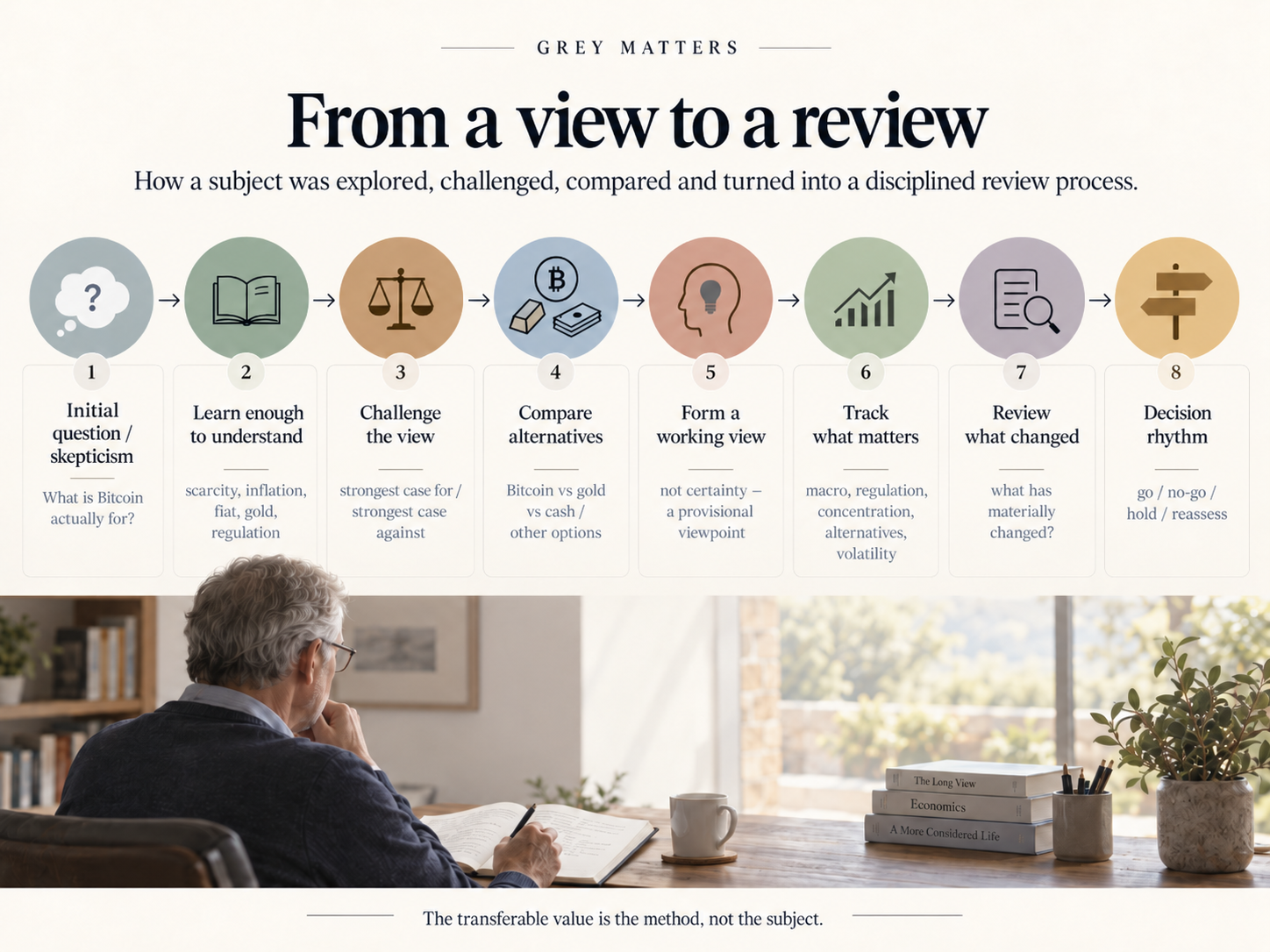
Once that working view existed, the problem changed. The question was no longer “Should I believe in Bitcoin?” It became: has anything materially changed? If price moved sharply, macro conditions shifted, regulation tightened, concentration increased or alternatives improved, we looked again. The view became something to revisit rather than defend.
From a view to a review
This is the point where the case moves from subject matter into method. The story is not simply that a view changed. The story is that the subject was explored, challenged, compared and then turned into a monitored go / no-go decision process.
Revisit rather than defend
AI did not tell me what to believe. It helped widen the question set, compare arguments, expose assumptions, connect macro developments, surface second-order risks, remember prior reasoning and ask whether a new development was genuinely material or just noise.
The human still had to decide what mattered, which arguments were plausible, which risks were tolerable, what evidence was strong enough to move the view, and ultimately accept responsibility for the decision.
The biggest change was not simply a conclusion about Bitcoin. It was the way the conclusion was held: opinion → challenged view → working viewpoint → continuing review.
Transferable lesson
State the view. Find the strongest challenge. Compare alternatives. Make assumptions explicit. Decide what would change your mind. Then keep checking.
The goal is not to eliminate judgement. It is to make judgement harder to fool.
Human + AI
| Human | AI |
|---|---|
| Experience · judgement · risk appetite · plausibility · values · final responsibility | Breadth · comparison · challenge · synthesis · continuity · alternative explanations |
Boundaries
- Not investment advice.
- Not a recommendation to buy Bitcoin.
- Not a claim that the current view is correct.
- No personal portfolio values, purchase history or returns.
- The case is about thinking discipline, not asset promotion.