
Previous state · T0
2026-09-14
BASELINE SURVEY
COMPATIBLE / NON-DISTINCTIVEHuman-led. AI-enabled. Start with what matters.
CGS / TERP · Method & Evidence Observatory
Creating an idea is the enjoyable bit. Trying to prove yourself wrong is rather less comfortable.
← The artefactsCreating an idea is the enjoyable bit. Trying to prove yourself wrong is rather less comfortable.
By the time we reached CGS, the problem had changed. We were no longer asking only whether we could make the idea more coherent.
What evidence would strengthen it? What evidence would weaken it? What evidence looks relevant but actually says nothing about it? And who gets to decide when the position should move?
That required something different from another conversation. It required a research method — and eventually, somewhere to see the state of that research.
That became the TERP Evidence Observatory.
The danger was not disagreement. Disagreement is useful.
The bigger danger was a system that gradually learned how to agree with itself. If the same AI helps develop an idea, searches for evidence, interprets that evidence and then decides whether the idea has strengthened, confirmation bias can become beautifully organised.
So the method was deliberately designed to introduce friction. Not bureaucracy for the sake of it. Useful friction.
One general-purpose AI was no longer enough for the job we wanted to do.
Agentic AI means using several AI agents with distinct roles, scopes and responsibilities rather than asking one AI to do everything.
TERP uses that capability to create five bounded specialist perspectives: Philosophy, Physics / Quantum, Cosmology, Life Sciences and AI / Cognition.
We chose this approach for a practical reason. The system that helps create the proposition should not also be allowed to search, interpret and judge it from one undifferentiated point of view.
Agentic AI lets us introduce role separation, disagreement and challenge deliberately. It is also an important development in AI itself — one we wanted to learn how to use, and one other people may increasingly want to use when the work becomes complex or consequential enough to justify it.
Different agents. Different lenses. One proposition.
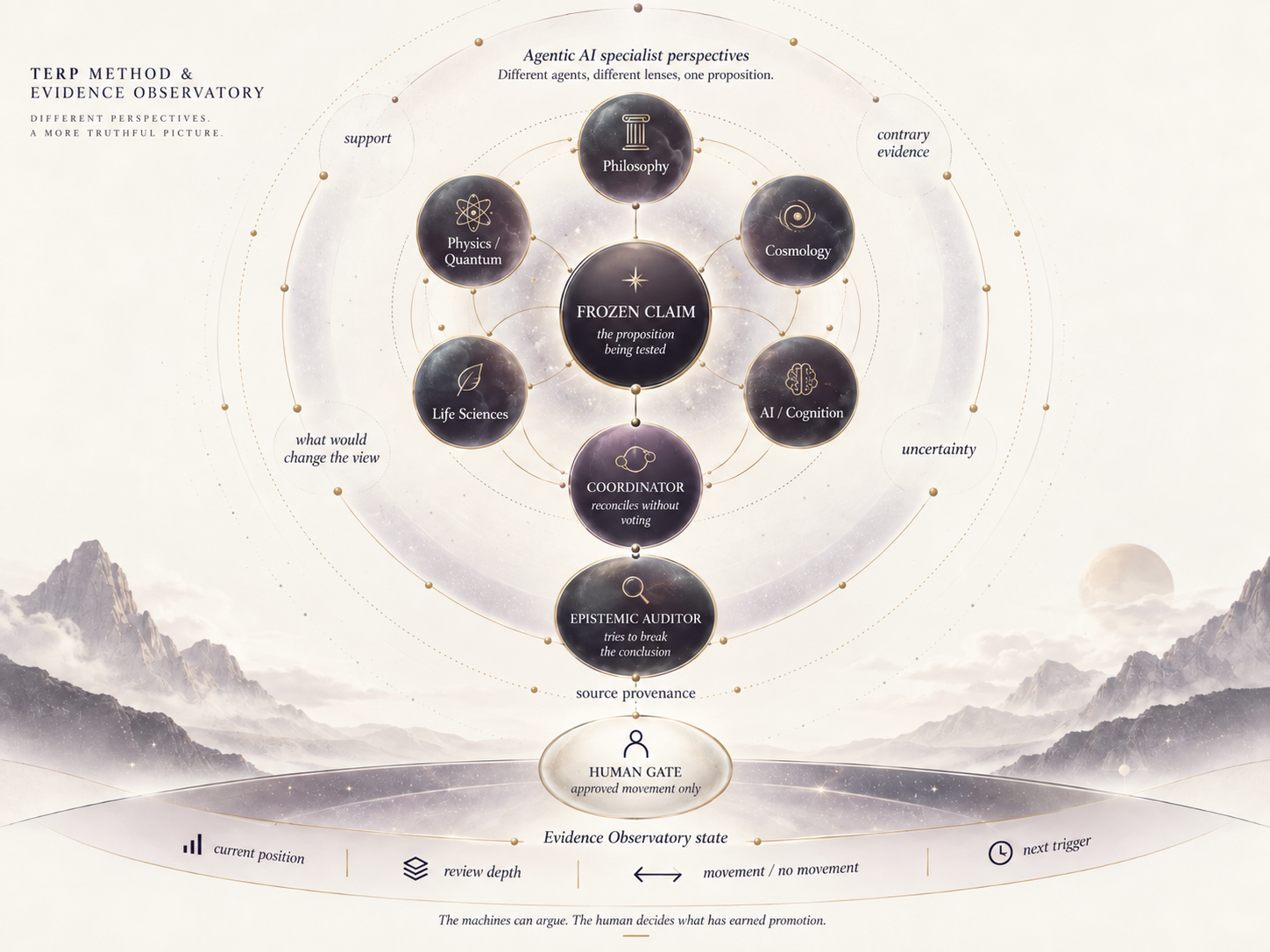
Before looking for evidence, TERP freezes the proposition being examined. If the wording of a claim changes while the evidence is being gathered, an awkward result can simply be absorbed by subtly changing the question.
CLAIM → FREEZE → SEARCH
You cannot fairly test a moving target.
CGS crosses questions touching several different disciplines. A physicist may notice something a philosopher does not. A cosmologist may interpret relevance differently from a life scientist. An AI / cognition specialist may see an analogy that is useful in one regime but misleading in another.
Each Agentic AI specialist therefore works within a bounded role rather than impersonating every discipline at once.
All five perspectives examine the same frozen claim. They may disagree; they do not vote on truth.
Five opinions do not become truth because three agree.
The Coordinator brings the specialist work together, but it does not conduct a vote. Different specialists may be addressing different parts of the question, and disagreement may itself carry information.
Its job is to reconcile overlap, preserve disagreement, distinguish shared evidence from shared language, identify where conclusions genuinely connect and make a bounded recommendation.
Consensus can be informative. It is not a substitute for reasoning.
After the specialists and Coordinator have done their work, an independent Epistemic Auditor challenges the result.
Its job is not to produce another opinion. It asks whether the process itself has cheated: whether the evidence really addressed the frozen claim, whether contrary evidence was handled fairly, whether analogy became mechanism, whether uncertainty disappeared during synthesis, and whether the conclusion became stronger than the source material justified.
This is where the architecture becomes more than a multi-agent workflow. It becomes adversarial review.
This internal AI-assisted challenge is not external peer review or scientific validation.
The AI system can research. It can compare. It can classify. It can challenge. It can recommend.
But it cannot silently change the approved research position.
Only an explicit human-approved promotion event moves the controlled TERP state.
The machines can argue. The human decides what has earned promotion.
The public evidence landscape
48 propositions. Different narrative regions. Evidence position and review depth are separate.
CGS is a conceptual framework, not validated science. This map reports the approved assessment state dated 14 September 2026; it does not prove CGS. Established surrounding science does not validate the wider framework.
Narrative groupings help orientation. They do not imply chronology, causality, dependency or evidential support.
Node fill and letter: evidence position. Single border and “1”: Baseline Survey. Double border and “2”: Focused Review. Full Audited Review is not recorded for these nodes. More review does not mean stronger evidence.
A claim can be reviewed more thoroughly without becoming better supported.
Baseline Survey → Focused Review → Full Audited Review
A deeper review may increase confidence in the assessment process without increasing confidence in the claim itself.
Looking harder and finding the same answer is not the same as finding stronger evidence.
What changed — and what did not
A non-trivial organisational relationship involving alternatives, filtering, retention and changed future possibilities may recur across domains with different mechanisms.
2026-09-14
BASELINE SURVEY
COMPATIBLE / NON-DISTINCTIVE2026-09-14
FOCUSED REVIEW
COMPATIBLE / NON-DISTINCTIVEComparison: Scope revised. Evidence movement: None.
Level-2 outcome: Mixed / unresolved. A predeclared three-domain intervention test found substantive local retained-state and intervention evidence, but did not establish a restrictive transformed recurrence across all three domains. The evidence status remains Compatible / Non-Distinctive. Assurance depth increased to Focused Review. T1 used a narrower operational scope and different denominators: comparison is Scope revised, not a directional evidence movement.
Can the four-part organisational relationship be mapped across domains in a restrictive, measurable way, despite different implementing mechanisms? The stronger universal-process variant is outside scope. A shared mechanism is not required by this candidate and must not be smuggled into its success test.
Maturity: Moderate · Component and formal literature, not complete cross-domain validation
Discrimination: Low · Complete four-part cross-domain translation
Test the predeclared R1/E1 acquired-state intervention mapping across trained particulate suspensions, donor-DNA bacterial heredity and neural learning. Selective post-acquisition retained-carrier disruption should reduce a history-specific later response with adequate general capacity and readout attribution. This is a narrower operational subset of PRN-025, not a replacement of its wording or complete scope.
Maturity: Moderate · Component studies in the selected material, hereditary and neural systems; complete R1 transfer not established
Discrimination: Low · Predeclared R1/E1 three-domain intervention mapping against analogy and generic causal mediation
Whiteboard accepts the bounded Level-2 assessment as a valid deeper-assurance historical event. PRN-025 remains COMPATIBLE / NON-DISTINCTIVE, with Moderate maturity and Low discrimination. “Scope revised” applies only to the T0↔T1 comparison because T1 tested a narrower operational subset with different denominators; it does not amend the controlled PRN wording or authorise a new permanent PRN scope. T0 remains preserved. No Level-3 review is authorised.
T0 PILOT-PRN-025-20260914 → T1 L2-PRN-025-20260914-01
Looking harder and finding the same answer is not the same as finding stronger evidence.
The Observatory is not just a snapshot. It is a visible history of reasoning.
Previous state → New evidence → Assessment → Human decision → Current state
Not every new paper strengthens or weakens CGS. Some evidence may be relevant background, compatible but non-discriminating, a constraint, an unresolved dependency, outside the claim's scope, or simply unable to distinguish the proposition from alternatives.
Research systems often reward movement. TERP deliberately allows no movement to be a legitimate result.
Sometimes the most important conclusion is: interesting, but it changes nothing.
The public Observatory is a window onto a deeper governed research environment. Research reviews, evidence ingestion, reassessment and approval remain inside the controlled TERP workflow.
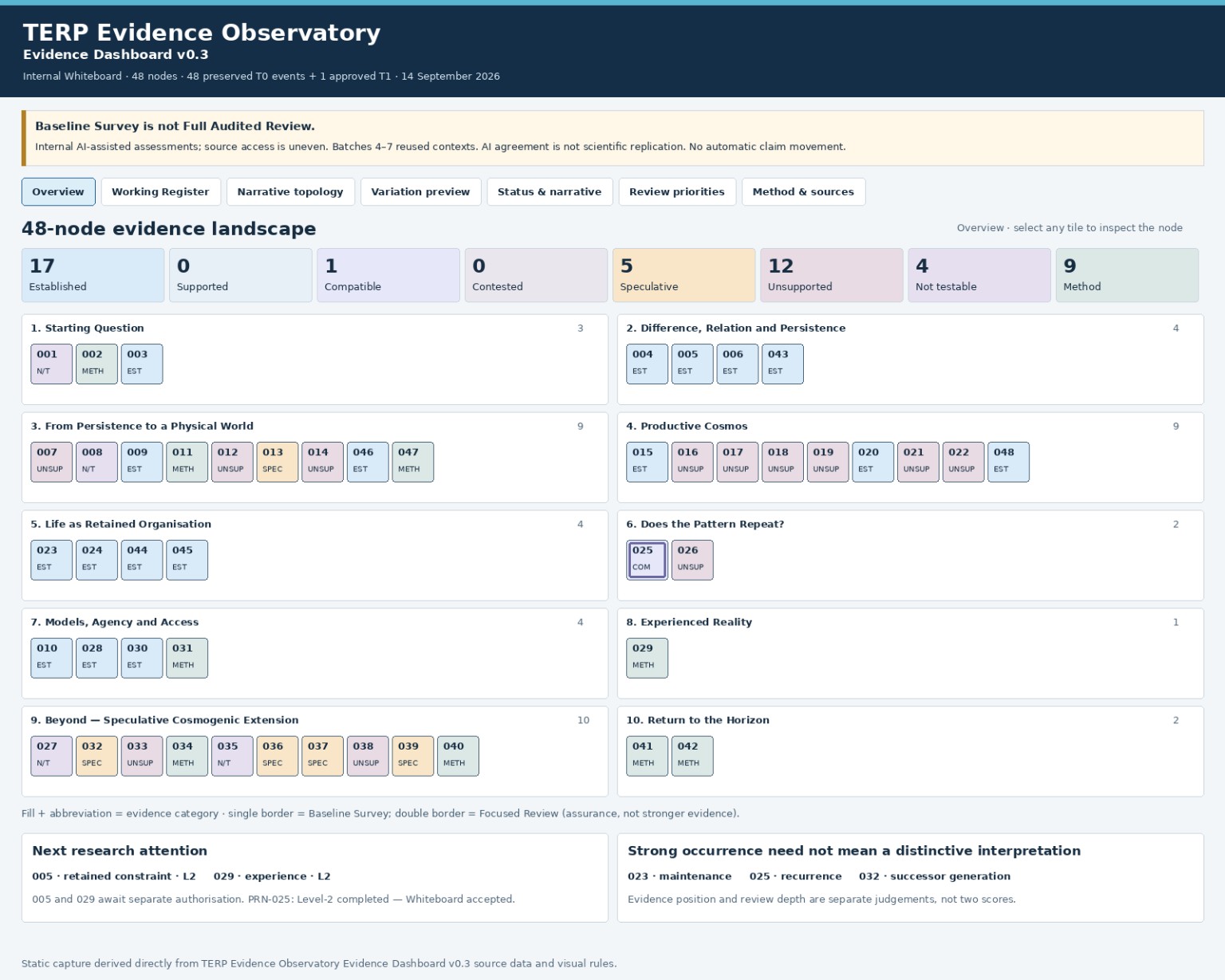
This is a static view of the governed internal research environment. The public Observatory is a publication window onto approved state. Internal research, reassessment, approval and writable controls remain private. The screenshot does not provide public operational access.
Show the state. Preserve the control.
AI agreement is not scientific consensus or replication. Source access is uneven; Baseline Survey is not Full Audited Review. Some survey passes reused AI contexts. The public website is a derived publication layer; controlled TERP state remains authoritative.
If you would like to challenge an interpretation, suggest relevant evidence, identify a source, propose a research question or offer specialist insight, we want to hear from you.
Papers, contrary evidence, criticism, alternative interpretations and specialist insight are welcome.
How to contribute research →The research contribution route uses our shared, human-managed Grey Matters email address. No website submission form is active.
Submissions enter discussion, provenance checking and verification. They do not automatically alter the Observatory; only the governed internal workflow and Human Gate can move controlled state.
The Library exposes approved claim, history and source wrappers while controlled TERP artefacts remain authoritative.