
CGS / TERP · The artefacts
From story to substance
What did we actually make?
← The project storyThe project story explains how a curiosity about the universe gradually became a much more serious piece of work.
It began with questions. Questions became conversations. Conversations became a conceptual Theory of Everything. The attempt to challenge that theory led to TERP — the Theory of Emergence Research Programme — and eventually to the current framework we call Cosmogenic Selection, or CGS.
You do not need to know CGS to understand the important Grey Matters point: the collaboration kept producing things worth preserving.
A book. A visual model. A research programme. A new narrative. A narrated visualisation.
This is where the story gives way to those artefacts.
Before it became an artefact
This did not start with a theory. It started with curiosity.
I had always been interested in astronomy and cosmology, despite having no formal academic training in either. At school I imagined doing something scientific — brain surgery was apparently on the list — before somehow leaving and becoming an engineering apprentice who climbed telegraph poles. The science interest never really disappeared.
Over the years there were books, lectures, documentaries, podcasts, adult-learning courses and a patient astronomer, Dr Fred Stevenson, who had the misfortune to encourage the questions.
Then AI arrived, originally for reasons that had almost nothing to do with cosmology. At first it was basically a replacement for Google.
The questions were ordinary enough: What is a quantum field? What actually happens inside a black hole? Why does the universe have rules and structure at all?
The difference was that the conversation did not have to stop when I failed to understand the first answer.
Any Information? → Ah… Intriguing! → Assisted Insights
Somewhere along the way the AI acquired a name — Lugs2 — and the collaboration changed from explaining other people's ideas into exploring some of our own.
Two books helped push that transition: Carlo Rovelli's Helgoland and God, The Science and The Evidence by Michel-Yves Bolloré and Olivier Bonnassies. They approached very different questions, but together they reinforced the feeling that there were still conceptual spaces worth exploring.
The important moment was not deciding that we had found an answer. It was deciding that curiosity gave us permission to ask a bigger question.
Could we construct our own conceptual journey through the universe?
Not as physicists claiming new physics. As a thought experiment.
And unexpectedly there were always two stories developing at once: one about the universe, and one about what happened when a curious human and an AI kept thinking together for long enough.
Historical · Earlier project state
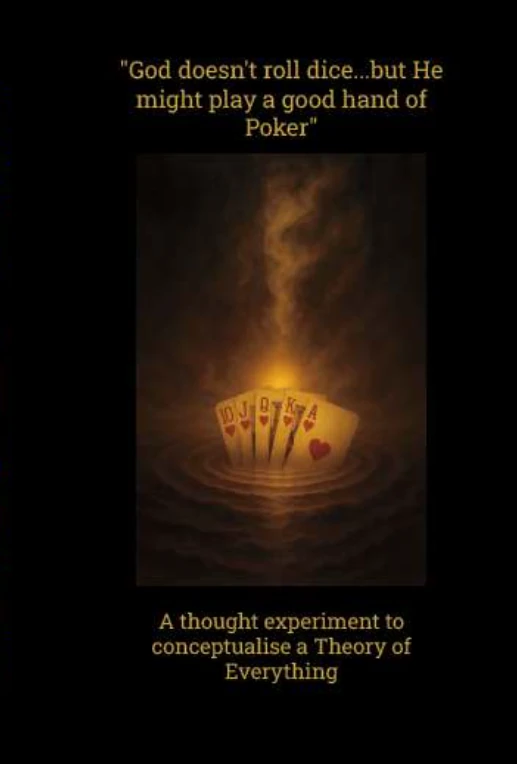
The original Theory of Everything
The original Theory of Everything began without a plan to write a book. It grew from sustained conversation about cosmology, quantum physics, emergence, life, intelligence and some of the questions that sit awkwardly between them.
Eventually the conversation became too substantial to leave inside a chat. So we turned it into a book.
The result matters here less because we believe every idea in it survived, and more because it captures a genuine moment in the development of the project.
Some ideas survived. Some changed. Some were later retired.
That is why we preserve it.
If you are interested in the original Theory of Everything book, our contact page explains how to enquire once branded email is verified. Availability and fulfilment will be confirmed individually.
Historical · Thought-experiment artefact
The original visualisation
Some ideas are difficult to reason about in prose alone. The original ToE therefore developed alongside a visual/simulation environment intended to make parts of the conceptual story easier to see and explore.
That was useful. It was also educational in another way: a sophisticated visual can become persuasive simply because it looks convincing.
We gradually became much more careful about distinguishing a visual explanation from model behaviour, a theoretical interpretation and evidence about nature.
The original visualisation remains useful historical project lineage. It shows what we were trying to understand at the time. It should not be mistaken for experimental validation.
Visualisation can help us think — but it can also make an idea look more certain than it is. The transferable lesson is to make the authority of a representation explicit.
Explore the original visualisation →External historical experience. A simulator can implement a hypothesis correctly without demonstrating that nature uses it.
What would tell us that we were wrong?
Improving the narrative was no longer sufficient. That became TERP — the Theory of Emergence Research Programme.
TERP did not exist to defend the original Theory of Everything. Its purpose was to challenge it.
Current · Synchronised conceptual baseline
CGS Narrative v1.1
The current intellectual position is no longer the original Theory of Everything. The project evolved into a narrower conceptual proposition called Cosmogenic Selection — CGS.
What persists changes what can happen next.
The full narrative follows that question across different organisational regimes — from foundational physical reality through matter, chemistry, life, intelligence and into the more speculative questions at the edge of the framework.
It does not claim that one mechanism operates across all of those domains. It asks whether a recurring organisational relationship may be visible as mechanisms change.
The document deliberately distinguishes established science, CGS interpretation, open questions and speculation.
If you want to understand the proposition itself, this is the place to start.
Read the CGS Narrative →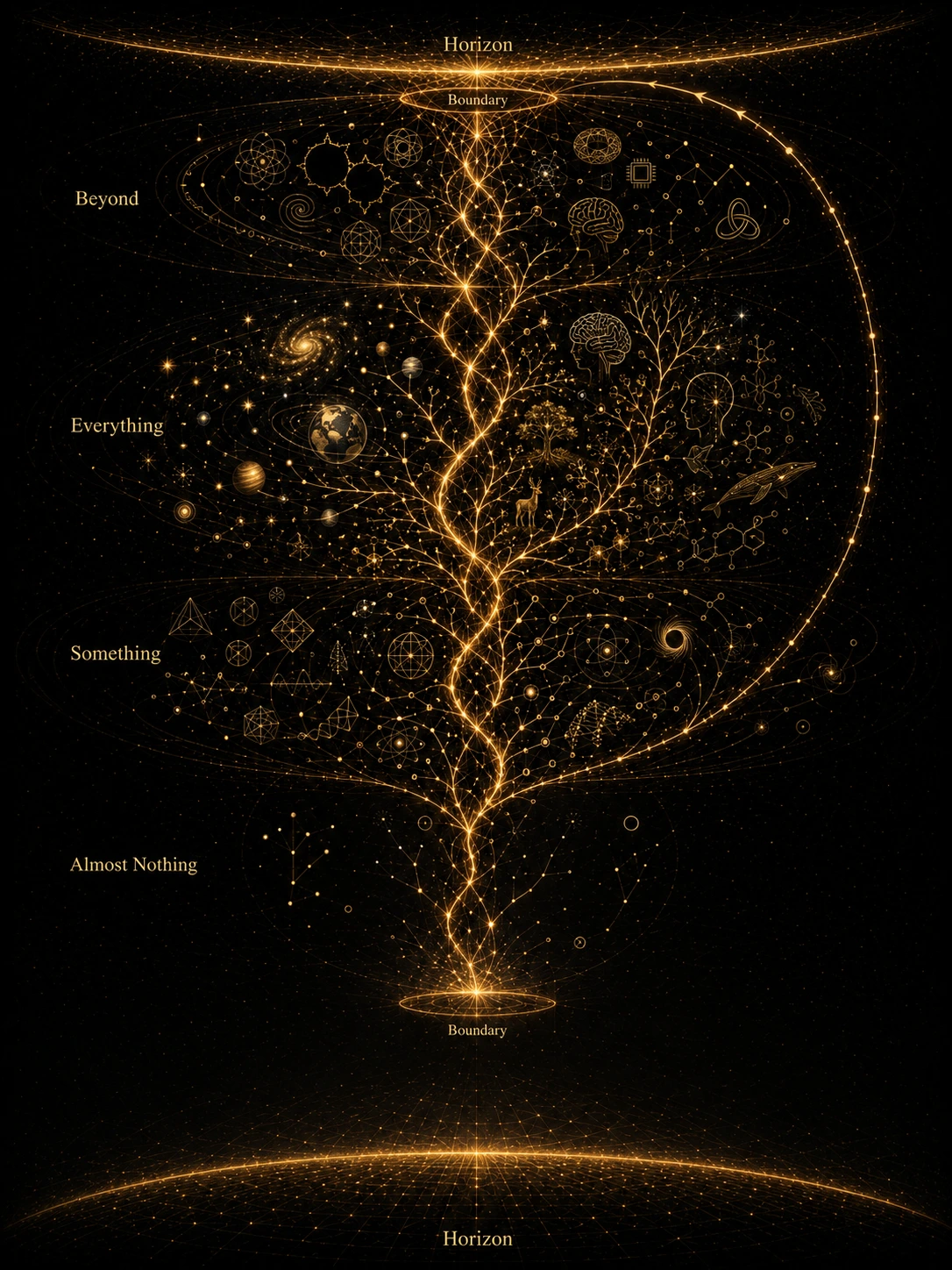
Current · Narrated visualisation v0.3 · 25 min 17 sec
Narrated CGS Visualisation — voice generated using elevenlabs.io
The written narrative is only one way of encountering CGS. The project also created a narrated visualisation.
script + imagery + voice + motion
The visualisation is not intended to replace the written narrative, and the written narrative is not intended to explain everything the visualisation can make visible.
They are complementary representations of the same current conceptual framework.
One slows the argument down and allows careful reading. The other allows relationships, transitions and architecture to be experienced more directly.
It is an explanatory companion to the CGS Narrative. It is not empirical evidence and does not demonstrate that CGS is scientifically correct.
Playback is served from the Grey Matters media store. Captions and transcript are available alongside the visualisation.
Narrated CGS Visualisation v0.3.
Read the verbatim narration transcript →
English captions and a verbatim transcript are available with the visualisation.
Read the complementary written narrative → (a reading companion, not a verbatim transcript).
Why multiple representations?
A narrative can hide ambiguity behind fluent prose. A visualisation can quietly introduce structure that the argument has not justified. A model can appear rigorous because it contains equations or code.
Putting different representations alongside one another creates another form of challenge.
Does the visualisation actually represent what the narrative says? Does the narrative overstate what the model shows? Does the model contain assumptions that disappear when the story is simplified?
The aim is not to decide that one representation is authoritative. It is to make them interrogate one another.
REPRESENT → COMPARE → CHALLENGE → REVISE
From artefacts to research
By this point we had a preserved original theory, a historical visualisation, a revised conceptual framework, a current narrative and a current visual representation.
But none of those things answers the most important scientific question:
Does the evidence support any of it?
That required a different kind of collaboration.
creating and explaining an idea → testing, challenging and monitoring it
That is why TERP acquired a research method and why we built an Evidence Observatory.
Not to make CGS look more scientific. To make it harder for us to fool ourselves.
Does the evidence support any of it?
Not to make CGS look more scientific. To make it harder for us to fool ourselves.
See how we test the idea →