
From curiosity to an idea we could challenge
It started with learning about cosmology and physics. Questions led to more questions, and eventually to original speculation: could the pieces fit into a conceptual Theory of Everything? The developing framework became the Cosmogenic Selection — CGS. It was a way of arranging and exploring the idea, not a scientific result that had been validated.
Models, visualisation and challenge gave us different ways to examine what we had made. Only later did the work grow into a wider research programme. The first idea was a starting point, not something we had to defend forever.
The more seriously we took the original theory, the more useful the failures became. Some starting assumptions reached too far. Some language implied more certainty than the evidence justified. The problem of moving from description to physical actuality would not go away. Instead of protecting the original version, we changed it. Claims narrowed. The scientific starting point moved. Earlier work remained visible as lineage rather than being quietly rewritten.
That is the heart of the Project story: sustained curiosity does not mean defending the first idea. It means staying interested enough to let the idea change.
When conversation became a sustained project
As the work accumulated, the collaboration crossed from Explore into Build. There were competing versions, changing claims, simulations, visualisations and manuscript variants. Open exploration stayed in Whiteboard. Controlled artefacts moved into Work. Speculation could remain alive without silently becoming the approved position.
| Whiteboard | Work | Public |
|---|---|---|
| Questions · speculation · challenge · alternatives | Approved narrative · controlled artefacts · versioned change · verification | Approved state only |
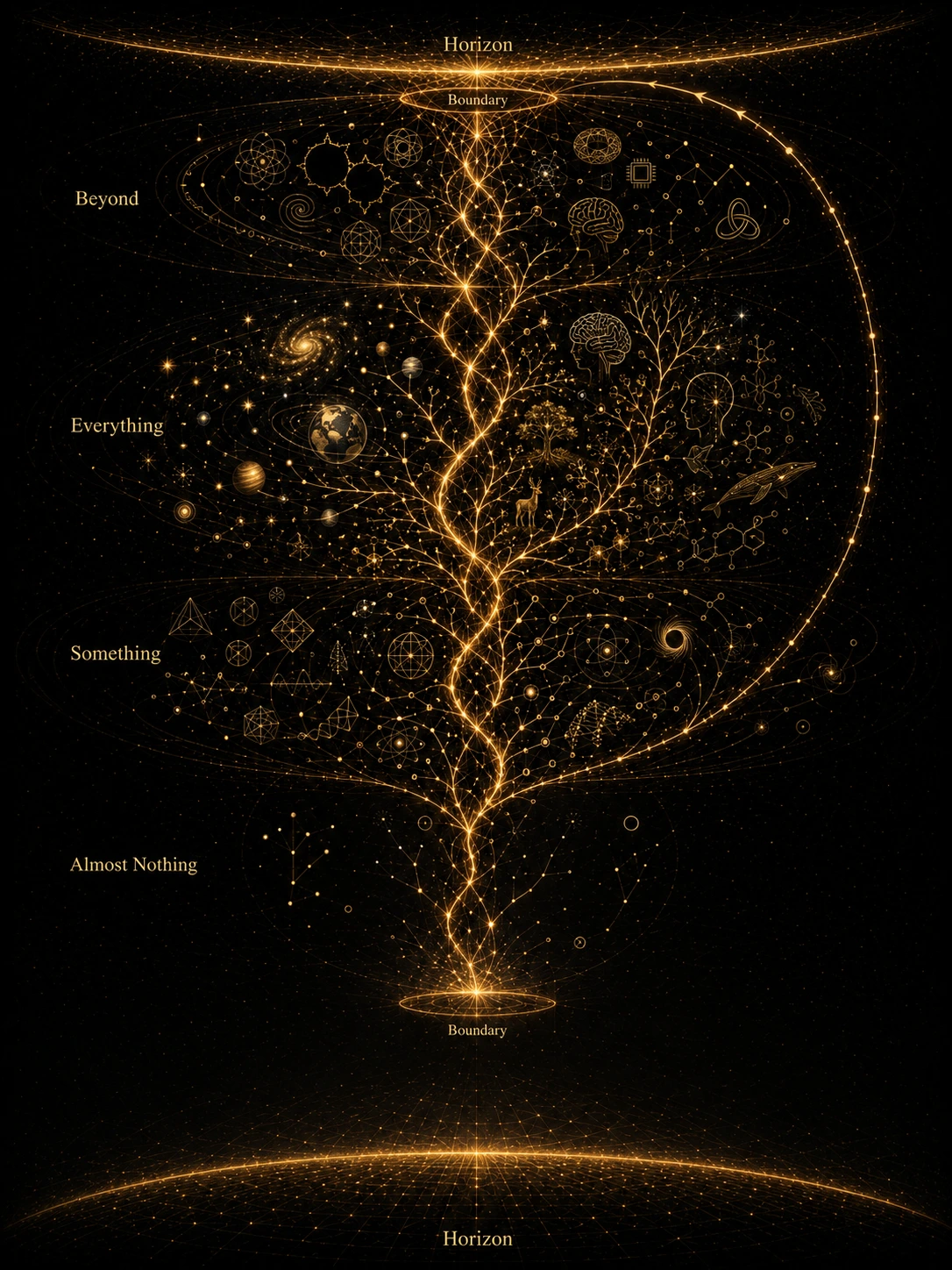
Visualisation became part of the reasoning: could the story be made coherent without the imagery implying more certainty than the narrative justified? The current narrated visualisation is therefore an explanatory companion, not evidence. The simulator similarly had to be demoted from something that looked persuasive to something with a precise status: model behaviour under stated assumptions is not the same as nature validating the model.
That distinction — explanation versus model behaviour versus empirical evidence — was another sign of the project maturing.
Visualisation and simulation do not prove the scientific hypothesis.
From explanation to evidence
Eventually a harder question became unavoidable: what would count as evidence, and what would tell us we were wrong? This wider work became the Theory of Emergence Research Programme — TERP. By then there was a reason for a research programme: separate the explanation from the evidence, preserve the claims and invite independent challenge.
Improving the explanation was no longer enough. The Evidence Observatory grew from the need to test whether external evidence strengthened, weakened or simply did not touch the propositions. The project acquired separated specialist perspectives, coordination, independent audit, contrary-evidence discipline and a human promotion gate.
| Specialists | Coordination | Gate |
|---|---|---|
| Philosophy · Physics/Quantum · Cosmology · Life Sciences · AI/Cognition | Coordinator → independent epistemic Auditor | Human approval before controlled research state moves |
By this stage the work was no longer just a manuscript. It had become controlled project state: claims, sources, reviews, historical positions, current positions, evidence that moved something, evidence that did not, open questions and triggers for reassessment. Long-running Human–AI collaboration needs memory that survives the conversation. Otherwise the project repeatedly rediscovers itself.
What changed about the collaboration
There are now two stories running in parallel. One is the intellectual subject itself. The other is what happens when a human and AI try to sustain a difficult creative and analytical project across a long time horizon. That second story is the Grey Matters story: curiosity remains alive, ideas are allowed to change, old work is preserved, artefacts accumulate, methods evolve and the collaboration becomes more disciplined as the project becomes more consequential.
Curiosity can survive revision. Preserving earlier versions and separating explanation, model behaviour and evidence made the work more useful than protecting the first theory.
What someone else can take from it
A visitor does not need to understand CGS to reuse the techniques. The visualisation pattern can explain a complex business strategy or technical architecture. Version lineage can preserve how an idea changed. Independent AI perspectives can challenge a long-running hypothesis. An Observatory-style evidence layer can monitor what would strengthen, weaken or overturn a position.
The science is the example. Sustained curiosity, externalised thinking, version memory, challenge and evidence discipline are the transferable value.
| Human | AI | Evidence |
|---|---|---|
| Curiosity · conceptual judgement · intuition · choosing what matters · accepting/rejecting revisions · final responsibility | Breadth · explanation · synthesis · alternatives · pattern recognition · drafting · research assistance · challenge · production | Published science · observation · experiment · external criticism · contrary results · uncertainty |
No one column gets to decide alone.
Very few visitors will want to build a theory of emergence. That is not the transferable lesson. The useful pattern is: Explore freely → preserve what you thought → challenge the foundation → separate explanation from evidence → preserve earlier versions → make claims explicit → search for contrary evidence → use independent challenge → change controlled state deliberately.