
It began with curiosity
Long before there was a website, a content architecture or a formal project method, there was simply a hunch: Human + AI collaboration might be genuinely useful to experienced people who still wanted to learn, explore, create and make decisions without becoming technology experts first.
The earliest collaboration was almost embarrassingly simple. Read something. Ask a question. Get an explanation. Disagree with it. Ask another question. Go a little deeper. One of the first serious explorations was cosmology. The human starting point was not formal expertise; it was interest, curiosity and a stubborn desire to understand difficult ideas well enough to keep asking better questions.
No line of code had to be written by the human. No server had to be configured. No network had to be connected. No image-generation system had to be engineered. None of that was the admission ticket. The useful starting point was much simpler: something you genuinely wanted to understand, solve, decide, create or build. Technical expertise can matter later, but it does not have to come first.
The original Theory of Everything project showed just how far that beginning could lead. It did not start with a plan to write a book. Reading became interactive; questions became persistent conversations; and those conversations developed into original conceptual thinking. Across seven threads, the dialogue grew into more than 2,000 pages of questions, explanations, arguments, metaphors, corrections and ideas. A finished book emerged from something that began because the universe was too interesting to ignore.
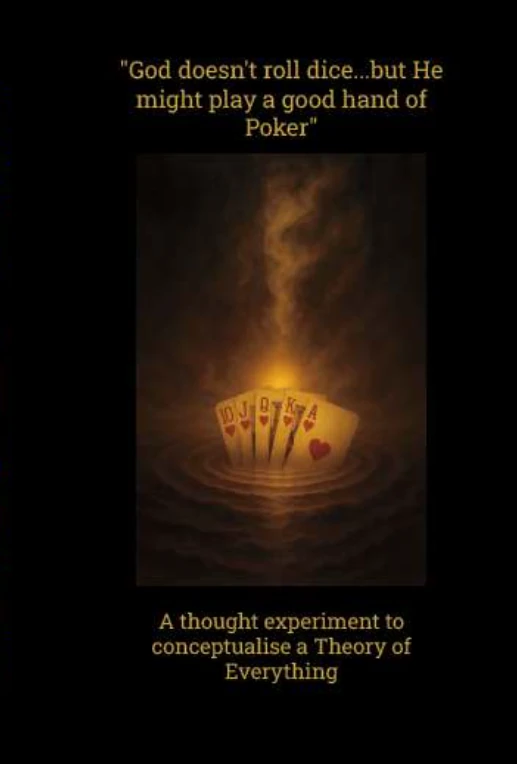
The manuscript deliberately contained two stories: the cosmological thought experiment and the evolution of the Human + AI collaboration that made it possible. With hindsight, the second story was the embryonic Grey Matters. The way we were working had become almost as interesting as the thing we were working on.
The original project reached a deceptively simple conclusion: you do not need to be a theoretical physicist to think deeply about the universe; you need the willingness to wonder. Grey Matters broadens that thought. AI reduces the friction between 'I wonder...' and 'Let's explore that properly.' The gain was not merely productivity, but the range of things one curious person could realistically attempt.
The collaboration became something more
Cosmology was only the beginning. The collaboration gradually spread into travel planning, garden design, the Living Decision Planner, Making Sense of a Changing World, Bitcoin analysis, research architecture, visualisation, family problem-solving and creative projects with a grandson.
The subjects were different, but something common was happening. Conversations were no longer useful only in the moment. They were producing documents, models, plans, images, frameworks, visualisations and recurring processes worth keeping. A holiday discussion became a Master Itinerary. A question about pensions and lifestyle choices became the Living Decision Planner. A speculative idea about the universe grew into a research programme. The examples accumulated first; the Grey Matters proposition became more credible because the work kept producing useful outcomes.
It was not a smooth journey. AI could confidently promise something and later discover it could not do it. Threads became too long; context disappeared; human prose was overwritten; reconstructed versions sometimes lost their personality. Image and diagram iterations could become endless circles of correction. Two major collapses during the original Theory of Everything project were particularly painful because valuable work had lived only inside the conversation.
Those failures changed how we worked. Thread collapse demanded persistence beyond the conversation. Overwritten prose demanded version control. Overconfidence demanded challenge and verification. Context loss demanded a reliable project state. Chaotic iteration demanded bounded ways of working. The method emerged from the scars, not from a desire to create an impressive process diagram.
We separated open thinking from controlled production. The Whiteboard became the place to speculate, challenge assumptions, consider alternatives, change our minds and occasionally try something silly. Work was used to turn agreed material into controlled, versioned artefacts with verification and human acceptance. Specialist tools entered where useful: other AI models, image generation, voice, coding and build environments. At times this effectively meant AI telling another AI what to do, which remains slightly odd.
Early conversations needed long prompts and repeated explanations. Over time, accumulated correction, preferences, vocabulary and shorthand reduced that overhead. 'Sketch the architecture.' 'Has anything materially changed?' 'Bring that back into Whiteboard.' Context itself had become an asset. We had begun accumulating not merely outputs but the ability to collaborate more effectively.
None of this formal method existed at the outset. Registers, version control and verification appeared only when the work became valuable, complex or consequential enough to warrant them. What began as conversation gradually became a repeatable way of working.
Building Grey Matters with Grey Matters
For a long time, the results existed as separate artefacts: documents, spreadsheets, a book, models, visualisations, research material and recurring briefings. Each had its purpose, but together they raised another question: how does somebody else understand what all of this adds up to?
That brought us back to Grey Matters — not as a conventional business proposition or a brochure about AI, but as a public home for the work, the learning, the method and the next experiments. Somewhere to make outcomes visible and share what sustained Human + AI collaboration had taught us.
Then the whole thing became pleasingly recursive. We needed to use the Grey Matters way of working to build the website explaining the Grey Matters way of working.
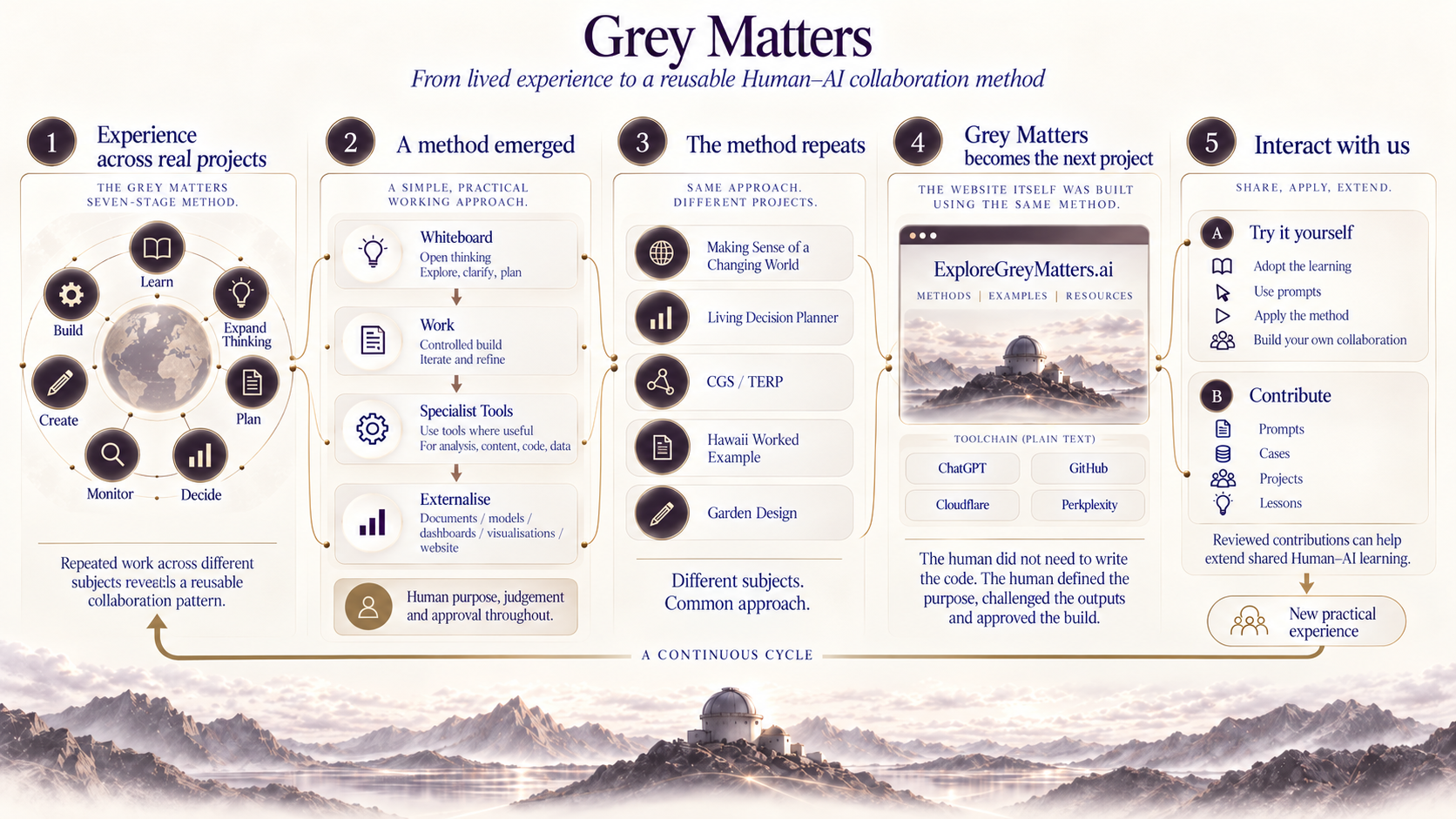
The process began on the Whiteboard: audience, proposition, seven ways of working, content depth, what should be public, what should remain private, and what belonged in Explore, Case Studies and Projects. Those discussions produced architecture documents, source registers, editorial narratives, visual decisions and build specifications before implementation began.
The website developed through bounded runs rather than one enormous instruction to 'build the website': repository and environment, design system, site shell, Explore routes, deeper content, Research Library, Evidence Observatory and the supporting technical and governance layers. Each stage inherited a baseline, had a defined purpose and returned for review. Some outputs were accepted; others needed correction or refinement.
A fast implementation engine can build the wrong thing very efficiently. Editorial judgement therefore remained separate from implementation. Whiteboard established the story; controlled build activity made it tangible; verification checked what was delivered; human judgement determined whether it was acceptable.
A conversation is temporary. An artefact persists. A versioned artefact can be compared, challenged, improved, reused, audited, linked and published. A conversation became a book. A planning discussion became a Master Itinerary. A decision became a living model. A speculative idea became a research programme. A collection of separate conversations and projects became Grey Matters itself.
The method helped create the website. The website now helps explain the method and what it enabled, while creating space for further learning. That is what makes Grey Matters a self-fulfilling project.
What someone else can take from this
Looking back, the most important outcome is not the website or even the individual artefacts. It is the accumulated capability that emerged from sustained collaboration.
The human brought purpose, curiosity, experience, intuition, taste, priorities and judgement. AI contributed breadth, speed, structure, comparison, drafting, consistency checking, iteration and production capability. Neither contribution was sufficient on its own. The value came from coordinating them, challenging weaknesses and keeping responsibility for consequential decisions human.
The evolving method supplied persistence, versioning, separation of thinking from implementation, verification, evidence and controlled approval. It meant we could retain what we learned instead of repeatedly starting again.
But nobody needs that entire machinery to plan a holiday or explore a difficult question. A visitor might simply recognise useful work trapped inside conversations, the frustration of repeatedly explaining the same context, or impressive AI outputs that were not always dependable. The transferable lesson is to make the collaboration proportionate to the task.
Start with one useful conversation. You do not need the method yet. If the conversation becomes valuable, preserve something. If the work repeats, add structure. If the consequences increase, add controls. If the project lasts, preserve its history. If other people might benefit, share what you have learned. Do not begin by building an elaborate system. Let the work earn it.
Grey Matters began with curiosity, moved through experimentation, success, failure and considerable rework, and became a way of working capable of producing things that once seemed beyond the reach of one person. The subject could have been cosmology, gardening, travel, investing, family history or something entirely different. What mattered was learning how to work with AI to extend human capability without surrendering human judgement.
And that brings us back to where we started.