
Choose what matters
Separate essentials from things that aren't important.
Human-led. AI-enabled. Start with what matters.
Explore · Decide
Put the trade-offs on the table. Keep the choice human.
Start with a choice you actually need to make. Which car fits the way you drive? Is the cheaper quote really better value? Which holiday gives you what matters without paying for things you do not care about? The same discipline can scale to decisions with much bigger consequences.
Try a comparison prompt
Separate essentials from things that aren't important.
Use the same questions for each option so you can see the differences.
Ask what changes under different assumptions, then make the decision yourself.
What this could help with
The method applies to everyday purchases, travel choices, quotes, subscriptions, home improvements, job options and larger life decisions. The common question is not 'what is best?' but 'what fits what matters to me, given the constraints?'
What transfers: I have limited resources. How do I use them well?
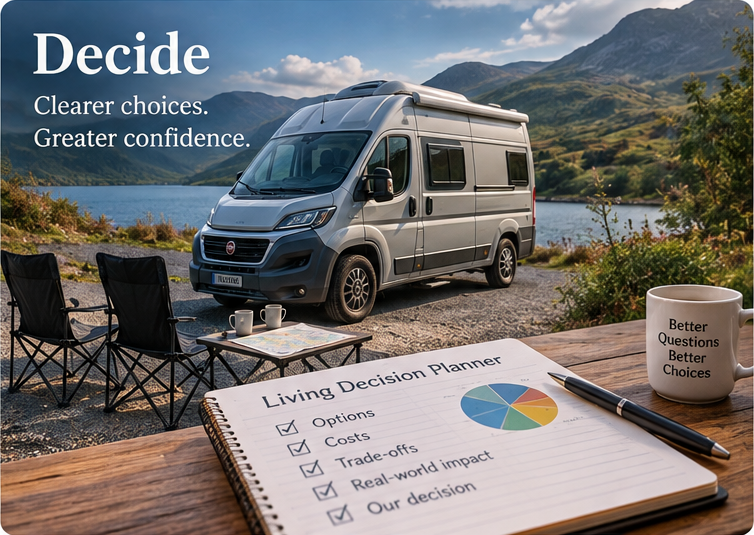
Our example — how we used it
Our examples happen to involve retirement decisions, where the stakes can feel quite practical. Once regular earnings stop, resources are finite and mistakes are harder to undo. For us, the point was not to maximise spending; it was to use what we had carefully, understand the trade-offs and get as much value as we reasonably could from the years ahead.
With the camper van, “Which van do we like?” became “Which option fits the life we actually want?” once the real constraints appeared.
The Living Decision Planner is the higher-consequence version of the same discipline, testing scenarios and resilience over a longer horizon.
AI can help
AI can organise items, compare the options and explore what alters when an assumption changes.
You still decide
You decide what matters most, verify the facts and retain responsibility for the decision.
Try it yourself
I need to choose between [options]. Help me define the criteria that actually matter, identify the important trade-offs, challenge any assumptions I may be making, and compare the options against the same criteria. Do not make the final decision for me. Show me what I would be giving up as well as what I would gain.Adapt this prompt