
Life decisions rarely arrive neatly packaged
Some decisions are the nice ones. Can we take the holiday? Do the kitchen? Buy the van? Help the children? Retire a little earlier? Others are less welcome. Income changes. A relationship changes. Health changes. A job disappears. A parent needs help. Costs rise. Something you expected to be stable suddenly is not.
Different decisions have different emotional weight, but they share a practical problem: one choice usually changes something else.
That was the reason for building the Living Decision Planner. Not to produce a perfect financial answer, and certainly not to replace professional advice. It was to create a calm place where we could ask: if we do this, what else moves?
The support around you may look very different
People make important decisions with very different levels of support. One person may have a wealth adviser or independent financial adviser. Another may talk things through with a bank, a lender, a trusted friend or a family member. Many people simply have to work it out for themselves.
The value of planning first is that it puts you on the front foot. If you later need to speak to an adviser, a bank manager, a lender or someone offering hire purchase or other finance, you arrive knowing what you want, what you can comfortably commit to, what trade-offs you are willing to make and which questions still need answering.
That changes the conversation. Instead of starting with 'What can you offer me?', you can start with 'This is what matters to me, this is what I have already tested, and these are the areas where I need your expertise.'
Where our version started
Our own version was triggered by real lifestyle and life-choice questions. Some were enjoyable choices; others were simply part of planning for a different stage of life. What mattered was being able to explore the consequences before committing to a decision.
Then real life gets involved. Costs move. Income can change. Inflation and tax rules shift. Family priorities evolve. Sometimes the question is something enjoyable, like a holiday, a home improvement or a camper van. Sometimes the choice is less optional and needs a calmer look at what happens next.
The useful question was not 'Can AI make the decision for us?' Absolutely not. It was: 'Can we understand the choice, see what else it affects and walk into any conversation about funding or advice properly prepared?'
What emerged is broader than pensions or formal financial planning. It is a living decision tool for ordinary life choices: connect the resources you have, the circumstances around you and the choice you are considering, then make the likely consequences visible and understandable before you decide.
It can help with everyday spending, saving, work, retirement, moving home, supporting family, travel, home improvements, major purchases or simply deciding how much flexibility you want to keep for the unknown.
- What do we want to do?
- What does it cost or change?
- What has to give elsewhere?
- What assumptions are we relying on?
- What happens if things go less well than expected?
- Do we still feel comfortable with the choice?
Know what matters, make the assumptions visible, compare the options, understand the consequences, then keep the choice human.
That became the most useful question in the whole process.
If we take the holiday, renovate the house, reduce work, support a family member or buy something substantial, what changes elsewhere? Does the cash buffer shrink? Does a later choice become harder? Does the plan become more exposed if markets or income disappoint? Or is the effect small enough that we should simply get on with living?
Different choices. Same question: if we do this, what moves?
Our end-to-end process — and when to use it
This is the end-to-end process we developed for our own Living Decision Planner. It brings together our personal position, decisions we are considering, and relevant external context from Making Sense of a Changing World. That wider monitoring helps us identify changes that may affect an assumption, rather than treating every headline as a reason to change plans.
Not every everyday decision needs the full breadth of this model. For many choices, a simpler comparison of what matters, what we know and what might change is enough. We expect the full process to be most useful for larger or more material decisions, particularly when choices interact or their consequences unfold over time.
That is how we intend to use it. Others may choose a lighter or more detailed approach to suit their circumstances. The model supports the conversation and makes trade-offs visible; it does not make the decision for anyone.
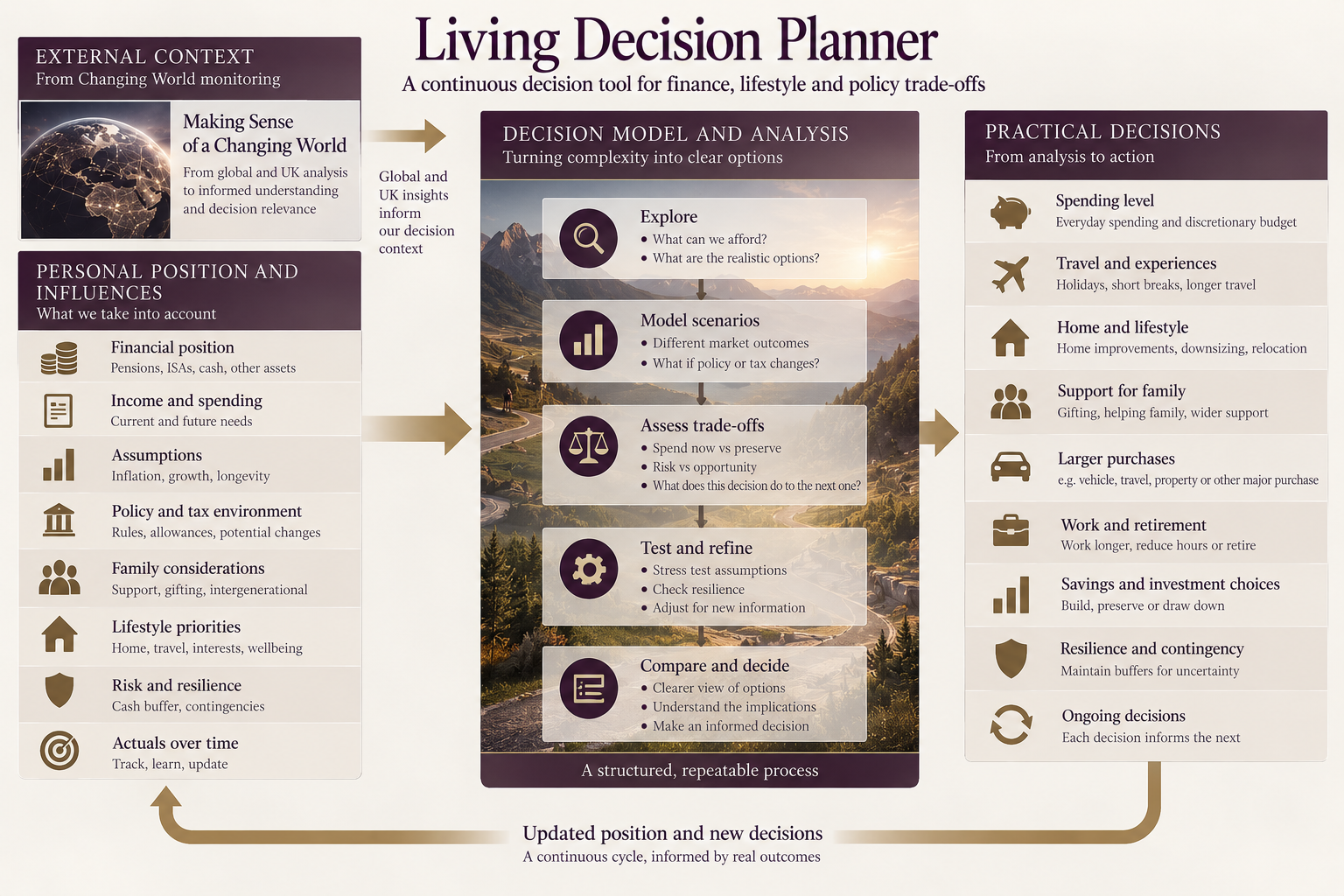
Behind the scenes, our version became quite detailed. It brought together adviser inputs, actual spending, policy changes, markets and lifestyle choices, then tested different scenarios.
But the purpose was never the spreadsheet. The purpose was the conversation it made possible.
The same process in five practical steps
What we know
- Income
- Savings
- Costs
- Advice
- Known commitments
What we are assuming
- Inflation
- Growth
- Future spending
- Timing
- Uncertainty
What we could do
- Option A
- Option B
- Do nothing
- Wait
What changes
- Cash
- Flexibility
- Risk
- Later choices
- Resilience
What we choose
- Human judgement
- Values
- Comfort
- Timing
A development in inflation, tax, energy costs, interest rates or policy matters here only if it changes an assumption relevant to a decision. We check the significance for our own circumstances before changing the plan; a headline alone is not a trigger.
Changing World can provide context. Only material changes should flow into a personal decision.
Making Sense of a Changing World →
Changing World monitoring → UK / local relevance → planning assumption → Living Decision Planner → human choice.
Numbers are useful. Explanation is essential.
A model can tell you what happens if an assumption changes. It cannot, by itself, tell you what that means for your life.
So we created a separate plain-English explanation alongside the calculations: what changed, why it mattered, what the main trade-offs were, where uncertainty remained and what we thought was worth considering next.
The spreadsheet answered 'What happens if...?' The explanation answered 'So what does that mean for us?'
Model
What happens if...?
Plain-English explanation
What does that mean?
Options
What could we reasonably do?
Human decision
What fits our life?
Where AI helped
AI was useful because it could keep track of assumptions, compare alternatives, challenge inconsistencies, test 'what if?' questions and remember how the reasoning had changed.
It also brought patience. Rechecking a model for the fifth time is not usually the highlight of anyone's week.
Where people still matter most
The important parts stayed human: what matters to you, what feels like enough, what risk you can live with, what you want to preserve, what you are prepared to give up and what the money or resources are actually for.
Where professional advice is useful or required, use it. Where trusted people can help, involve them. The benefit of doing some thinking first is that you can use those conversations better. AI can organise, explain and challenge; it should not quietly become the person making the choice.
Human + AI + other support
Human
- Purpose
- Values
- Priorities
- Comfort
- Judgement
- Final responsibility
AI
- Structure
- Comparison
- 'What if?' testing
- Explanation
- Consistency
- Memory
Other people / professional support
- Advice
- Experience
- Challenge
- Specialist knowledge
- Emotional support
- Second opinion
Where we landed
The biggest benefit was having a process we could return to as life changed, without rebuilding the whole decision from scratch.
Instead of waiting for an annual review or reacting to a big life event with no structure, we had a living workspace that could absorb a change and ask: 'Does this actually alter anything?'
Sometimes the answer was yes. Quite often it was no. Both are useful.
What someone else can take from it
You do not need our finances, our adviser, our spreadsheet or our life choices.
Start with one real decision. Write down what matters, what you know, what you are assuming and what else might change if you go ahead. Ask AI to help compare the options and explain the consequences in plain English. Then make the decision yourself.
The point is not to optimise every part of life. It is to make important choices with your eyes open.
Boundaries
- Not financial, tax, legal or medical advice.
- Not a replacement for professional help where professional help is appropriate.
- Not a prediction of markets or future events.
- Public examples use fictional, illustrative or sanitised information only.
- No real pension values, household income, adviser identities or other unnecessary personal financial detail.