

From reading the news to asking better questions
Making sense of what is happening in the world is difficult. The 24-hour news cycle is noisy, repetitive and often emotionally exhausting. One headline says everything has changed; a few hours later another says almost the opposite. We wanted something calmer and more consistent: a way of cutting through the noise, understanding what had genuinely changed and forming a considered view without being pulled up and down by every breaking-news alert.
There was never a shortage of information. Quite the opposite: headlines, Substacks, podcasts, markets, wars, elections, AI announcements, energy policy, scientific papers and people confidently predicting the end of everything by Thursday. The useful question was not 'How do I get more news?' It was 'How do I make sense of any of this without spending my entire life reading it?' That was the beginning. Not a news service. Not a dashboard. A conversation.
The first briefings were deliberately short: a handful of developments, only where something looked genuinely consequential. That quickly changed the habit from 'What happened today?' to 'What changed?' Most news is not change. Much of it is repetition, positioning, recycled claims or commentary on something already known. So the daily habit became an exercise in subtraction: What is genuinely new? Why does it matter? Does it change anything we thought yesterday? If not, move on.
Some of the terminology in this project is our own. It developed naturally as the collaboration evolved and as we built a system that helped us make sense of a changing world. Words such as rotation, aggregation, standing watch and working view came to carry specific meaning for us. We decided not to strip all of that language out for publication because it is part of the project story and part of the way the collaboration now works. We explain each term in plain English when it first appears, but keep the shorthand where it's useful.
If you develop a deeper, long-running project with AI, you may find the same thing happens. You start creating your own names, shorthand and shared meanings that reflect how you think and what you are trying to achieve. That is perfectly normal — and probably something to encourage. The language becomes part of the collaboration’s working memory.
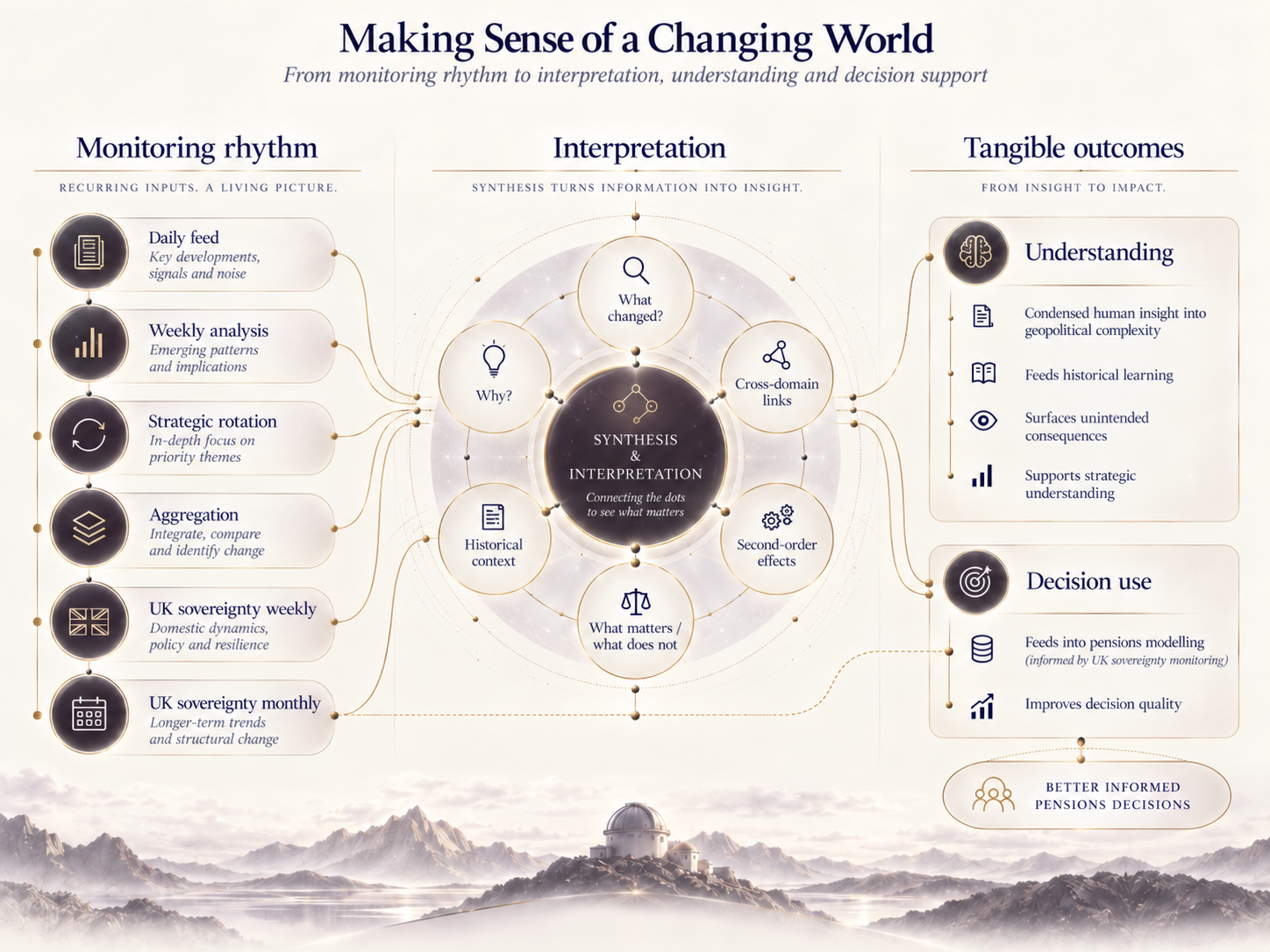
This illustration captures an earlier stage of our monitoring approach. What we originally called UK Sovereignty is now presented as UK Relevance. Pensions modelling was one early application; the broader principle is connecting global developments to decisions through our Living Decision Planner.
The conversation became a monitoring process
The best part was rarely the briefing itself. A single item might trigger: 'Hang on — why is that happening?' Then: 'Is that really new?' Then: 'Has something like this happened before?' An apparently simple signal could lead to an impromptu deep dive across history, energy, technology, economics or geopolitics. That made the monitoring interactive. One signal triggered discussion. Discussion triggered a deeper question. A deeper question sometimes became something we deliberately kept an eye on because a future change would matter.
A rhythm emerged, but it stayed flexible. We did not need every subject every day.
- Daily: what changed since yesterday?
- Weekly or weekend: what deserves more time and thought?
- Every few weeks: return to a subject and see what has actually moved, what has not, and whether our earlier concerns still hold.
- Occasionally: put several themes beside one another and ask whether a wider pattern is emerging.
Internally we sometimes called those returns 'rotations' and the wider pattern-check 'aggregation'. For a reader, the simpler meaning is enough: come back after time has passed, compare with the previous position and see what is genuinely different. The cadence created discipline without becoming a prison. If something genuinely interesting cut across the schedule, we followed it.
Daily monitoring gave us situational awareness. A weekend long read slowed things down and asked what was really going on underneath a topic. Returning to a theme after a few weeks let us ask what moved, what did not, which concerns strengthened, which faded and where we were simply wrong. Putting several themes beside one another asked a different question again: is a wider pattern emerging? Any resulting world model stayed provisional until repeated evidence supported it.
From individual events to the wider picture
Energy became industrial policy. Industrial policy became productivity. Productivity became fiscal capacity. AI became energy demand, labour, national capability and semiconductor dependency. Taiwan became TSMC + ASML + supply chains + US strategic bandwidth + munitions + Japanese resilience + Chinese readiness. Bitcoin conversations wandered into monetary history, sovereign debt and financial repression. The world does not organise itself according to our folder structure. So the project gradually shifted from monitoring topics to monitoring relationships.
At some point, simply summarising the separate subjects stopped being enough. We began putting them beside one another and asking a harder question: what kind of wider pattern might these signals be describing? One example was the relationship between national capability, competition and cooperation. More capable states might still cooperate. Or capability might increasingly become a zero-sum contest. Rather than choosing one answer too early, we kept two plausible explanations alive and watched which one the evidence began to support.
The work occasionally moved from observation into tentative prediction, but not in the sense of publishing ten forecasts for next year. The discipline was simpler: if this interpretation is roughly right, what should become visible next? What would strengthen it? What would weaken it? That created something useful: a working view could be revisited later rather than remembered only when it happened to be right.
What we think may be happening → what we would expect to see next → what evidence would weaken it → return when new evidence arrives.
Current events often present themselves as unprecedented. Sometimes they are. More often there are useful historical echoes — not exact repetitions, but mechanisms worth understanding. So the analysis began asking: what was intended, what happened immediately, how did people adapt, what second-order effects appeared, and what became structural over time? That opened a richer layer: history became a way of identifying which consequences might now be worth watching, not a machine for predicting the future.
Policies and strategies are designed for intended outcomes. Systems respond. People adapt. Capital moves. Markets route around restrictions. Competitors and adversaries react. So another standing question appeared: 'What happens next that the people designing this probably did not intend?' That moves monitoring from headlines toward mechanism.
Russia / Ukraine became a particularly useful test because competing sources could make the same event appear to support opposite conclusions. We therefore became more explicit about what was independently confirmed, what each side claimed, what outside evidence supported or contradicted those claims, what remained uncertain and why the difference mattered. The result was sometimes less exciting. It was also more useful.
What do we know? What is being claimed? Who says it? Is there independent support? What remains unresolved? If the claim is true, why would it matter?
Making global change relevant to our own lives
That is where the UK Relevance strand developed. Global change becomes useful and relevant when it eventually impacts the UK, our local area and ultimately our own lives. For us, that means asking what major shifts in energy, debt, productivity, technology, defence, supply chains or policy might mean for the UK.
The aim is not to turn every headline into a personal alarm. It is to follow the transmission path: global change → UK consequence → local relevance → possible personal impact. Most signals stop well before that point. A headline is not a personal decision trigger. But where the chain becomes material, the monitoring can feed a separate Living Decision Planner, where personal choices and trade-offs are tested properly.
Where monitoring meets decision-making → Living Decision Planner
What emerged, and what someone else can take from it
If you monitor war, debt, AI risk, state capacity and geopolitical competition every day, it is quite easy to conclude that civilisation will end before lunch. So we deliberately added a counterweight: genuine positive signals in science, engineering, conservation, health and occasionally an endangered animal doing rather better than expected. The good-news menagerie is not fake optimism. It is an editorial reminder that monitoring should improve our perception of reality, not systematically darken it.
Some of the most valuable moments never became formal reports. They were the back-and-forth: 'I don't buy that.' 'What evidence supports it?' 'That seems too simplistic.' 'What if the opposite is true?' 'Does this connect with what we saw last month?' Those conversations changed what we monitored next. The project became a record of ongoing thinking being shaped by incoming reality.
We did not set out to build our own news programme, but that is more or less where we landed. It is part news briefing, part Question Time, except the discussion is interactive: we can stop it, challenge an argument, ask for another source, revisit something said last week and decide whether anything genuinely changed. That was an unintended consequence of a long-lived conversation. We started by trying to read the news more intelligently. What emerged was an ongoing panel discussion with memory.
We reduced volume when there was too much information, focused on material change rather than whatever was merely interesting, and learned to ask 'So what?' before giving a signal more attention. We separated confirmed facts from claims and uncertainty, and added historical context and second-order effects where a headline alone was insufficient.
When AI flattened disagreement, we kept competing explanations alive. When the same story returned, we compared it with the previous position to see what had actually changed. When another theme kept being added, we made the framework more selective and proportionate.
Monitoring became more useful when separate signals produced a clear, testable working model. The point was not to declare the model correct. It was to make it possible to revisit and challenge. The transferable lesson is simple: do not stop at 'What happened?' Ask 'What might be forming?', 'What would we expect to see if that were true?' and 'What would make us change our mind?' A company, family, investment question, research project or community issue can use the same discipline.
| Human | AI | External reality |
|---|---|---|
| Curiosity · scepticism · priorities · judgement · interpretation · decision ownership | Breadth · speed · source comparison · continuity · cross-domain connection · recurring production | Events · data · policy · markets · scientific evidence · contradictions · things that refuse to fit the story |